A drain that clogs once is a nuisance. A drain that clogs every few months is telling you something about the pipe, and in Lincoln what it's saying depends a lot on when your house was built. This guide explains how to tell a simple blockage from a sewer problem, what you can safely try yourself, and when to stop trying.
Drain cleaning means clearing the pipe and finding out why it blocked
When a plumber talks about drain cleaning, they mean getting a blocked line flowing again: pulling the trap under a sink, running a cable (a snake or auger) down the pipe, or flushing the line with water under pressure. That's the clearing part.
The other half is working out why it blocked. If a ball of hair blocked the tub drain, taking it out fixes the drain for good. Roots in a sewer joint are a different story. You can cut them back and the drain will run, but they'll grow back into the same joint. A good drain visit should leave you knowing which of those you had.
What plumbers recommend you try first
For a single slow sink, tub or shower, most of this is within reach of a homeowner:
- Clean the stopper and strainer. Bathroom sink pop-ups and tub strainers collect hair and soap. Pull them out and clean them before you do anything else.
- Use a plunger properly. Use a cup plunger for sinks and tubs and a flange plunger for toilets. Block the overflow hole on a sink or tub with a wet cloth so the pressure goes down the pipe, not out the top.
- Take the trap apart. The U-shaped pipe under a kitchen or bathroom sink usually unscrews by hand. Put a bucket under it first. A lot of kitchen clogs are sitting right there.
- Try a small hand auger for a blockage just past the trap.
- Keep grease out of the kitchen sink. Let fats cool in a can and put them in the garbage. Wipe greasy pans with paper towel before washing them. Grease goes down warm and sets up cold further along the pipe.
- Fit hair catchers in tubs and showers.
Most plumbers will also tell you to go easy on chemical drain openers. They rarely shift a solid blockage, and if they don't work, the pipe is now full of something caustic that you, or the next person, has to work around.
Boiling water helps less than people think
Pouring boiling water down a drain can loosen fresh soap scum or a thin film of grease in a kitchen sink. That's about the limit of it. It won't move hair, food scraps, wipes or roots, and the grease it melts often just sets again a few metres further down, where it's harder to reach.
It can also do harm. Many sink drains are plastic, and boiling water can soften the joints over time. Never pour it into a toilet, because a sudden rush of heat can crack the porcelain. Hot tap water and a bit of dish soap do most of what boiling water does, with less risk.
One slow drain is local. Several at once is the main line
If only the bathroom sink is slow, the problem is in that sink's branch. If the toilet gurgles when the washing machine empties, the shower drains slowly whenever the dishwasher runs, or water comes up through the basement floor drain, the blockage is further down, in the main line or the sewer pipe that leaves the house.
The basement floor drain is the lowest opening in most houses, so it's where a main-line blockage shows up first. If you see water there that you didn't put there, stop running water in the house until the line is cleared.
Lincoln's houses clog in different ways
Lincoln's housing comes in roughly three ages, and each has its own usual suspects.
Before 1945: the older parts of Beamsville, the brick houses of Jordan and Jordan Station (many built between 1900 and 1910), and Rittenhouse Park in Vineland Station, laid out in 1912, were all built before the war. Houses of this age typically have cast iron drains running to a clay tile sewer. Clay comes in short lengths, and every joint is a place for roots to get in. A drain in one of these houses that blocks every spring or fall, and keeps blocking however well it's cleared, is very often roots.
The 1950s to 1970s: Beamsville got sewers in 1953 and Vineland started growing with subdivisions from 1970. Houses from these decades usually have a clay or fibre sewer pipe to the street. Fibre pipe can soften and go out of round with age, and both kinds let roots in. Many of these houses also have their foundation drains tied by gravity into the sewer, so heavy rain can push water back up into the basement even when nothing is "clogged" in the usual sense.
New builds: at Prudhommes, off North Service Road east of Victoria Avenue North, the houses have plastic drains and a PVC sewer with tight joints. A repeat clog here is much more likely to be grease, wipes or something dropped down a drain than a worn-out pipe.
When the camera should go down
Clearing the drain is the whole job when the line is sound and the blockage was something that went in from the top: grease, hair, wipes, a toy. If the cable comes back clean and the drain stays clear, you're done.
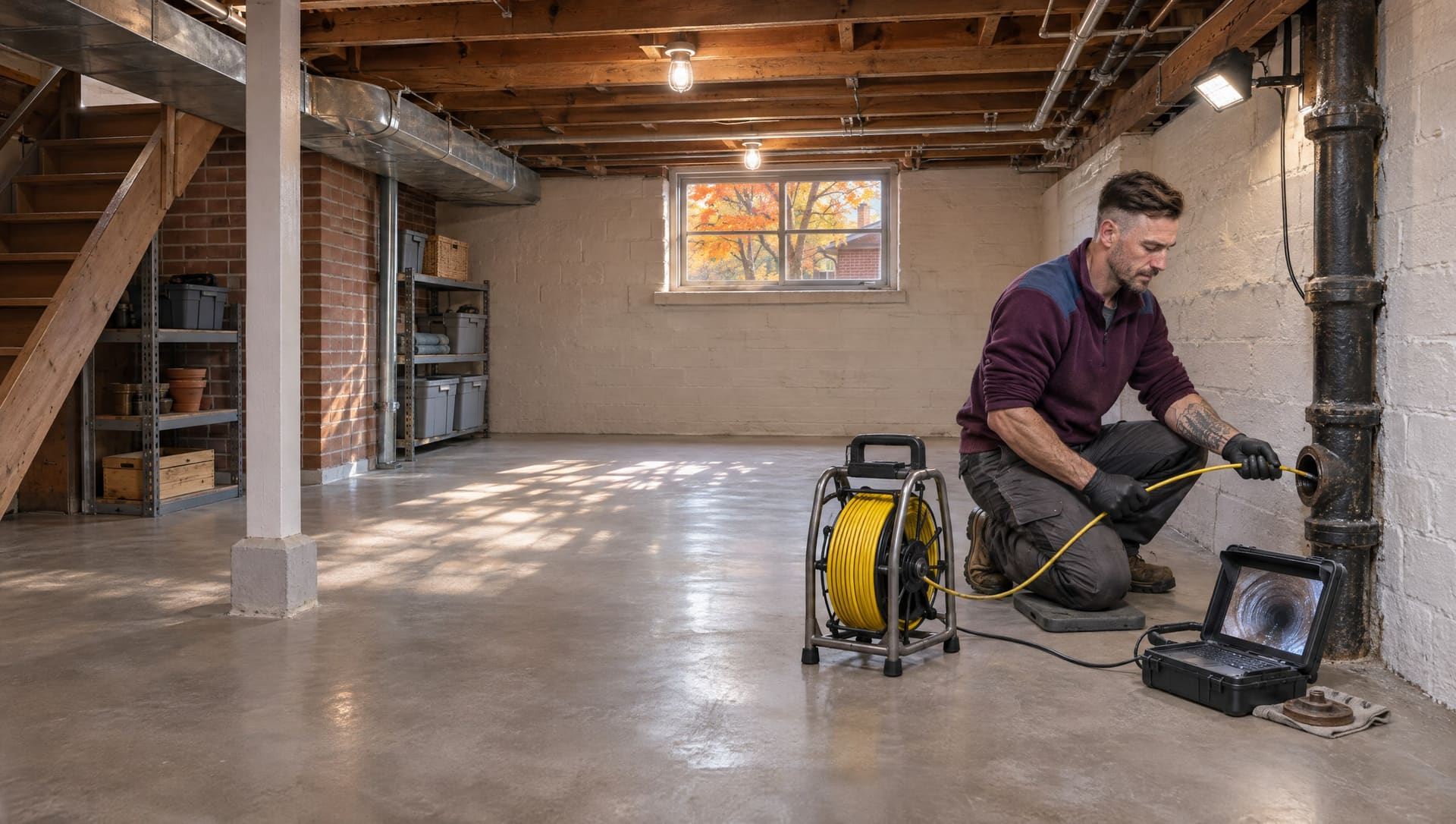
It's time to put a camera down the line when:
- the cable brings back roots, or bits of clay or dark fibre
- the same drain blocks again within a few months
- the basement floor drain backs up, especially after rain
- the house is older and nobody has ever looked at the sewer
- you're buying an older house in Beamsville, Jordan or Vineland and want to know what's under the lawn
A camera shows you where the problem is, how far from the house it is, and whether it's a root-filled joint, a sag that holds water, or a cracked or collapsing section. That tells you whether regular clearing will do, or whether a section of pipe needs to be replaced.
The sewer under your lawn is yours
In Lincoln, the property owner is responsible for the private sewer service from the property line to the house. If there's no suitable clean-out, the homeowner pays to clear a blockage wherever it turns out to be. That matters most when the cause is tree roots or grease build-up, which both tend to come back.
So it's worth finding out whether your house has an outdoor clean-out (often a capped pipe near the foundation or in the front yard). If it doesn't, adding one makes every future blockage easier to deal with. Replacing or adding to a drain line generally needs a building permit, and the Town's building department can tell you whether your job does. If the work means digging, a locate has to be requested through Ontario Dig Authority first. Public locates mark the utility lines but not your own sewer, which is one more reason a camera with a locator helps before anyone picks up a shovel.
Heavy rain and the backwater valve
On July 21, 2026, Lincoln got more than 110 mm of rain in just over an hour, and the Town has noted that rain that intense can overwhelm drainage systems. A house whose sewer is already partly blocked by roots has less room for that water. Older houses with foundation drains tied into the sewer are the most likely to see it come up through the floor drain.
If your basement has backed up before, look into the Town of Lincoln's subsidy toward a sanitary backwater valve. It's meant to reduce basement flooding from sewer backups in heavy rain or fast snowmelt. Funding is limited and given out first-come, first-served, and homeowners with a history of sanitary flooding are expected to benefit most. A valve doesn't clear roots, so it works best alongside a sewer that's in decent shape. Our page on sewer repair and backwater valves explains how the two fit together.
What to check before you call
- Is it one fixture, or several at once?
- Does the floor drain show water after rain, or when the washer empties?
- Roughly how old is the house, and are there big trees between it and the street?
- Is there an outdoor clean-out, and can you find it?
If it's one sink and the trap and plunger fix it, you've likely solved it. If it keeps coming back, or the floor drain is involved, it's time to look further down the line. Our drain cleaning page explains how we clear the line and when we bring the camera.